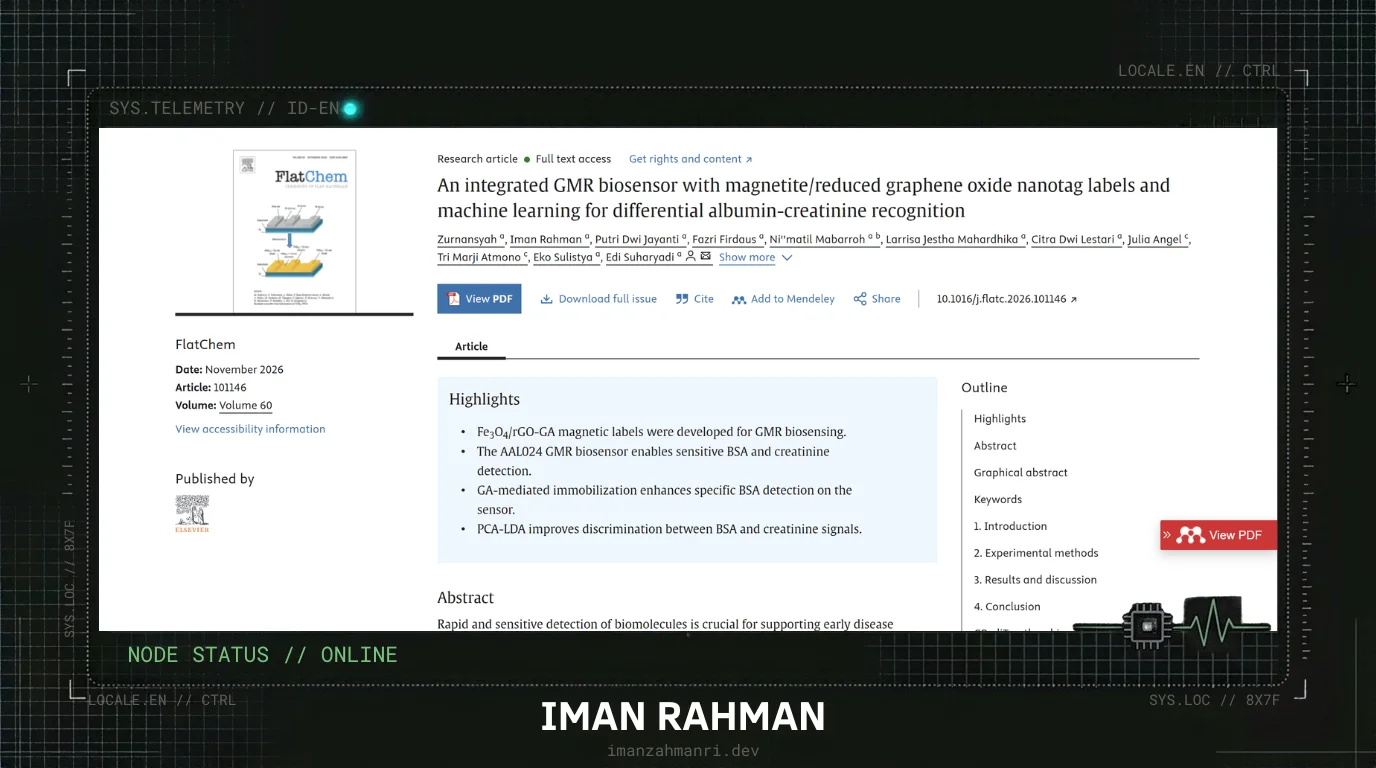
Differential Recognition of Albumin and Creatinine Using GMR Biosensors and Machine Learning
Exploring a novel giant magnetoresistance (GMR) biosensor platform utilizing Fe3O4/rGO-GA magnetic labels and machine learning to achieve highly sensitive differential recognition of kidney biomarkers.
Rapid and sensitive detection of biomolecules is crucial for supporting early disease diagnosis. Albumin and creatinine are widely used as primary biomarkers for assessing kidney function, and early detection of abnormal levels can help prevent progression to end-stage renal disease. In our recent publication in FlatChem, we developed a rapid, low-cost diagnostic platform by integrating a commercial giant magnetoresistance (GMR) biosensor with custom magnetic nanomaterials and machine learning (ML) analysis.
Engineering the Magnetic Nanotag Labels
To generate a reliable detection signal, we synthesized magnetite/reduced graphene oxide () nanocomposites using a green synthesis approach.
- We utilized Moringa oleifera (MO) and Amaranthus viridis (AV) leaf extracts as green reducing and stabilizing agents during synthesis.
- The nanoparticles provide the magnetic response, while the rGO matrix prevents nanoparticle agglomeration and oxidation.
- We functionalized the nanocomposite with glutaraldehyde (GA) to serve as a linker.
- GA forms strong covalent Schiff base bonds with the primary amine groups on proteins, facilitating stable biomolecule immobilization.
Sensor Performance and Biomolecule Detection
The sensing mechanism relies on the stray magnetic field generated by the magnetic labels. As biomolecules bind to the functionalized magnetic labels on the sensor surface, the effective stray field weakens, resulting in a measurable change in the GMR sensor's resistance and output voltage.
Our experimental results demonstrated strong linear responses:
- Bovine Serum Albumin (BSA): Achieved a sensitivity of . The Limit of Detection (LoD) was calculated at . The system showed excellent linearity with an value of 0.98.
- Creatinine: Achieved a sensitivity of . The LoD was calculated at . The system demonstrated linearity with an value of 0.95.
Enhancing Differential Recognition with Machine Learning
To further distinguish between BSA and creatinine at low concentrations (), we applied machine learning techniques.
- We extracted five voltage-based statistical features from the sensor signals: maximum voltage, minimum voltage, mean voltage, standard deviation, and the difference between maximum and minimum voltages.
- Principal Component Analysis (PCA) and Linear Discriminant Analysis (LDA) were utilized for feature extraction, which improved the separation of the biomolecule signals.
- When evaluating classification models, a Support Vector Machine (SVM) model achieved the highest accuracy of .
Read the full manuscript on ScienceDirect: An integrated GMR biosensor with magnetite/reduced graphene oxide nanotag labels and machine learning for differential albumin-creatinine recognition