Evaluating PM Filtration: Custom Instrumentation Setup for Novel Nanofiber Membranes
A look into our recent collaborative publication in Materials Advances, focusing on the custom-built Nano Filtrack setup and software used to evaluate the 99% filtration efficiency of a novel superhydrophobic PM1.0 and PM2.5 membrane.
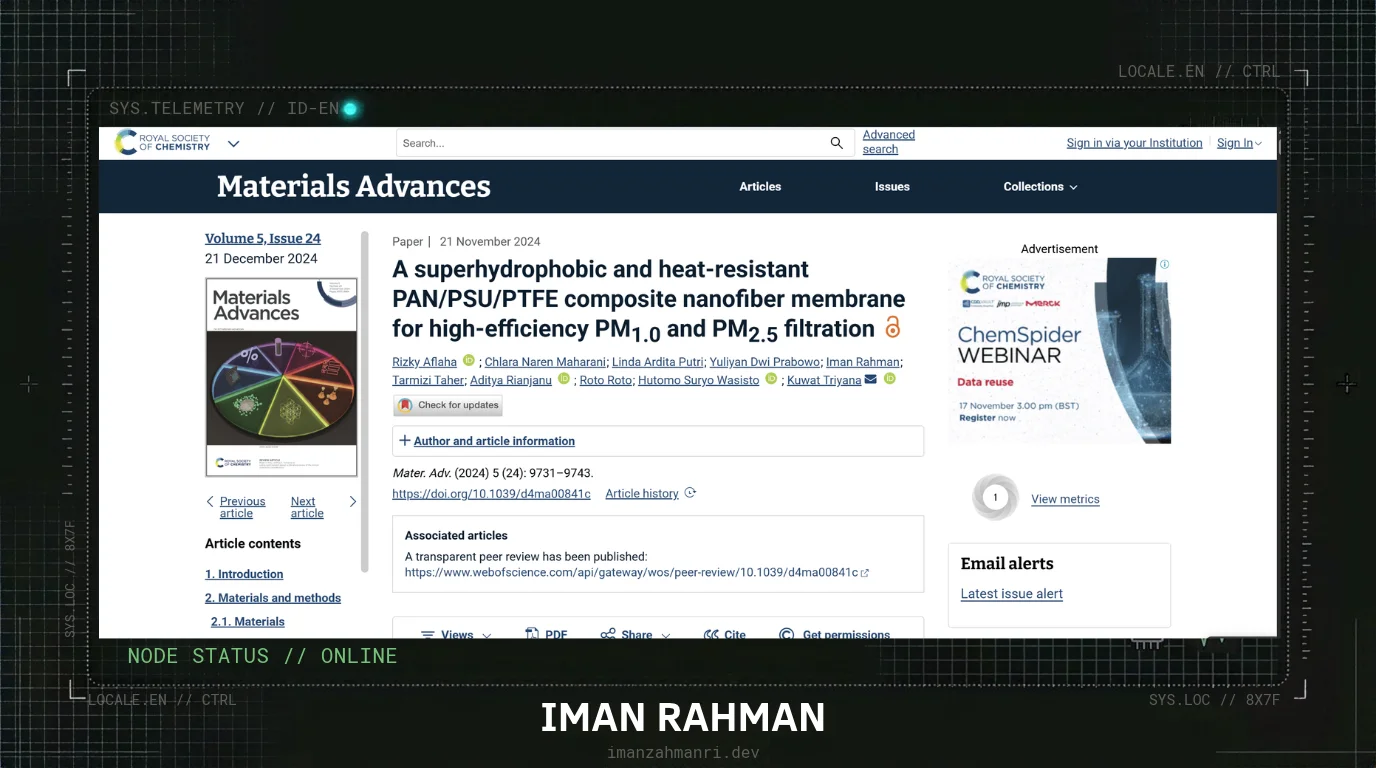
Our research team recently published a paper in Materials Advances (Royal Society of Chemistry) detailing a novel superhydrophobic and heat-resistant nanofiber membrane designed for high-efficiency air filtration. While my colleagues focused on synthesizing the PAN/PSU/PTFE composite, my primary responsibility was developing the testing instrumentation and software environment to accurately validate its performance.
Custom PM Filtration Setup (Nano Filtrack)
To rigorously evaluate the membrane, we utilized a custom-built PM filtration setup named Nano Filtrack at Universitas Gadjah Mada. The system is designed to introduce controlled particulate matter and precisely monitor concentrations in real-time.
The automated Filtration Test Site (FTS) integrates several key hardware components:
- An aerosol generator that dispenses potassium chloride (KCl) powder as the target PM source.
- Dual PM counter sensors positioned before and after the nanofiber membrane to continuously log and concentrations.
- A differential pressure sensor to monitor the pressure drop across the filter.
All sensor data is transmitted and stored on a personal computer (PC) to facilitate real-time calculation and logging.
Automated Performance Analysis
The software calculates the filtration efficiency () on the fly using the standard formula:
where and represent the PM concentrations before and after passing through the filtration membrane.
Using this instrumentation, we successfully verified that the fabricated membrane achieves a highly stable filtration efficiency of for and for . Read the full open-access paper at Materials Advances.