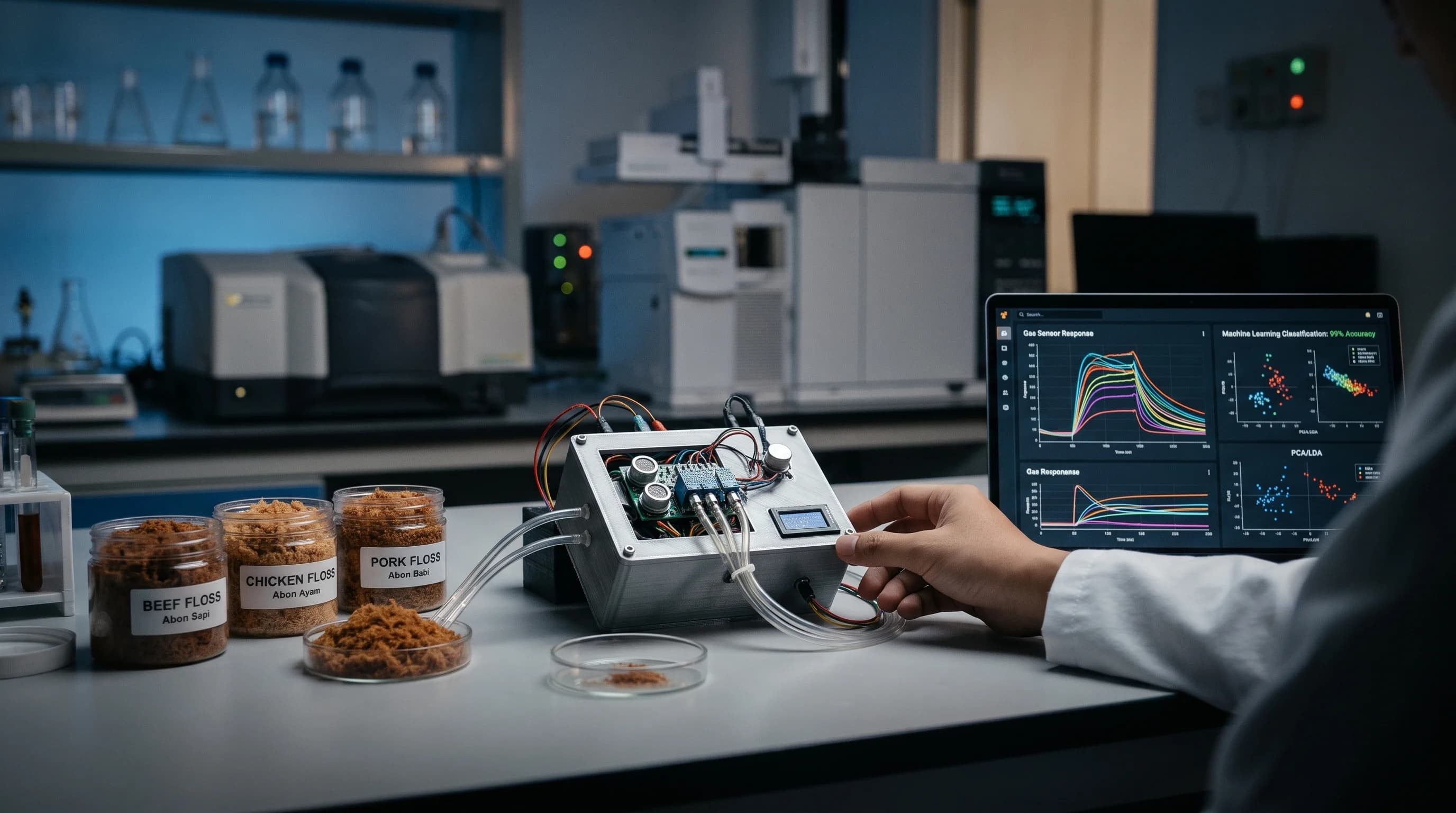
Rapid Analysis of Meat Floss Origin Using a Supervised Machine Learning-Based Electronic Nose
Discover how a compact, portable electronic nose (e-nose) combined with supervised machine learning achieves over 99% accuracy in identifying the origin of beef, chicken, and pork flosses, offering a rapid and non-destructive solution for food authenticity and preventing food fraud.
Introduction
Food fraud and the mislabeling of meat-based products are growing global concerns, particularly for processed foods like meat floss (locally known as "abon" in Indonesia), where visual identification is impossible. Traditional authentication methods like DNA testing (PCR) and chromatography are highly accurate but suffer from being time-consuming, expensive, and destructive to the samples.
In our latest study published in npj Science of Food (Nature Portfolio), we developed a non-destructive, rapid, and cost-effective alternative: a compact portable electronic nose (e-nose) powered by supervised machine learning to classify the biological origin of meat floss.
How it Works
The system utilizes a custom-built sensor array to "sniff" the volatile organic compounds (VOCs) emitted by different meat floss products.
- Sensing Phase: The head-space gas from beef, chicken, and pork floss is drawn into a sensor chamber.
- Feature Extraction: We utilized an advanced window time slicing method (specifically evaluating a 5-window slicing technique) to extract transient and steady-state features from the gas sensors.
- Classification: These features were used to train and test four supervised learning models: Linear Discriminant Analysis (LDA), Quadratic Discriminant Analysis (QDA), k-Nearest Neighbors (k-NN), and Random Forest (RF).
Key Findings
- High Accuracy: Among all algorithms, the Linear Discriminant Analysis (LDA) model achieved the highest performance, yielding >99% accuracy for both validation and testing data when distinguishing between beef, chicken, and pork flosses.
- Biochemical Correlation: The e-nose classification results were validated using Fourier-transform infrared (FTIR) spectroscopy and GC-MS. The chemical analysis revealed that beef and chicken have similar compound profiles (primarily hydrocarbons and alcohols), whereas pork floss is uniquely dominant in specific aldehyde compounds (such as dodecanal and 9-octadecanal), which our e-nose readily distinguishes.
- On-the-Field Applicability: Thanks to its lightweight, portable, and rapid signature detection, this device paves the way for ubiquitous, real-time food authenticity testing in the field.
Read the full research paper on Nature: s41538-023-00205-2.